

I’ve watched thousands of people start tracking their workouts. I built a tracking app, so I get a front row seat to the whole cycle: the excited first week, the slow fade, and for most people, the quiet disappearance somewhere around day twelve. It’s such a consistent pattern that I can almost predict it from someone’s first three log entries. The good news is that the people who don’t quit aren’t more disciplined or more motivated. They just do a few specific things differently, and those things are learnable.
The Friction Problem
The single biggest reason tracking dies early is that it asks for too much in the wrong moment. Someone finishes a heavy set of squats, chest heaving, and the app wants them to type in reps, weight, RPE, notes, and tag the muscle group before they can move on. That’s fine on day one when motivation is high. By day ten, that friction is the difference between logging the set and just doing the workout and moving on with your life. Willpower is a finite resource, and if tracking costs willpower every single set, it will lose to fatigue eventually. It’s not a character flaw. It’s just math.
Read: 8 Functional Exercises That Improve Both Strength and Endurance
The All-or-Nothing Trap
The second killer is the belief that a tracking streak has to be perfect to count. I see this constantly: someone logs eleven days in a row, misses a Tuesday because life happened, and instead of picking it back up on Wednesday, they just stop altogether. In their head, the streak is “ruined,” so what’s the point. This is the same trap people fall into with diets and journaling. A missed day gets treated as proof that the whole system failed, when really it was just one missed day. The people who stick with tracking long term have quietly made peace with imperfect data. A log with gaps is still enormously more useful than no log at all.
Tracking Everything Except What Matters
The third problem is more subtle and it’s one I didn’t expect when I started building for this. A lot of people who do stick with tracking for a while still quit, because they’re tracking the wrong things. They log body weight every morning, then get discouraged by normal day to day water fluctuation. They track every accessory exercise with the same intensity as their main lifts, so the log becomes noisy and hard to read at a glance. When you’re drowning in numbers that don’t mean anything, it’s exhausting to keep adding more, and there’s no clear signal telling you it’s working. Noise kills motivation just as fast as friction does.
No Payoff, No Reason to Continue
Tie those three together and you get the real root cause: no visible payoff. If logging a workout is annoying, if a broken streak feels like failure, and if the data you’re collecting doesn’t tell a clear story, why would anyone keep doing it? Tracking only survives past week two if it starts paying for itself, if opening the log actually shows the person something worth seeing.
Here’s what I’ve noticed the people who don’t quit actually do differently, none of it complicated.
Log During Rest Periods, Not After
People who stick with tracking log the set in the ninety seconds between sets, not at the end of the workout. It sounds like a small thing, but it removes the two biggest failure points at once. You’re not trying to recall four exercises’ worth of numbers from memory afterward, and you’re not adding a chore onto the end of a workout when you’re already mentally checked out and ready to leave the gym. Logging during rest turns tracking into part of the workout itself instead of an extra task bolted onto it.
Track One Number That Compounds
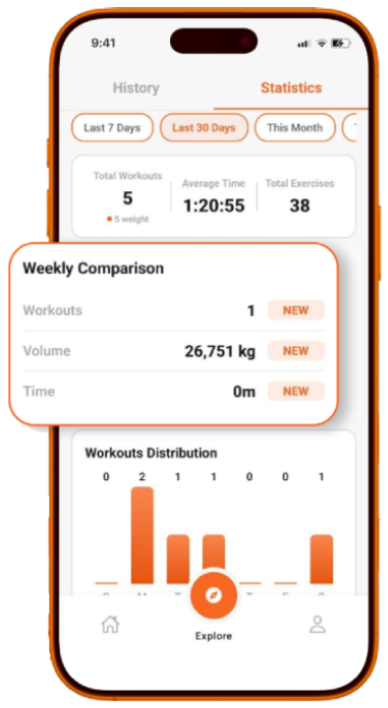
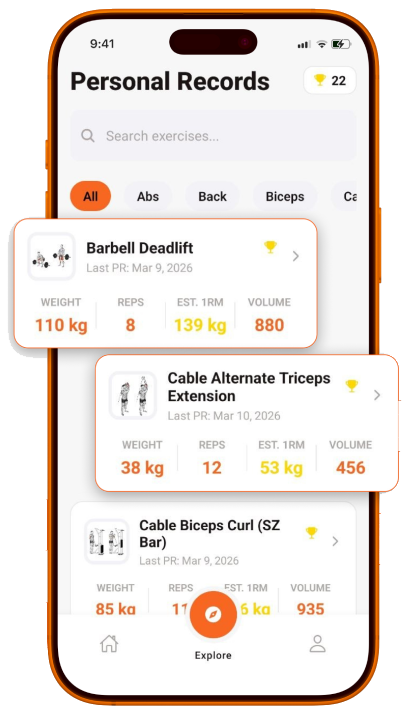
The second habit is narrowing focus to one number that actually tells a story over time, instead of a dozen numbers that don’t. The one I recommend most is estimated one-rep-max, calculated from whatever weight and reps you actually did that day. You don’t need to test a true 1RM to get value from this, a quick estimate from a working set (something like a free online 1RM calculator does automatically) gives you a single trend line per lift that goes up over weeks and months even when your day to day numbers bounce around. That one line is what makes the log feel like proof of progress instead of a spreadsheet of noise. It’s the difference between staring at forty data points and seeing nothing, and glancing at one graph and immediately knowing you’re stronger than you were six weeks ago.
Never Break the Chain Twice
The third habit is a rule, not a feeling: missing one day is allowed, missing two in a row is not. This comes from an old comedian’s trick for writing jokes every day, and it works just as well for training logs. One missed day is life happening. Two missed days in a row is the start of a new, worse habit. People who stay consistent for months aren’t the ones who never miss a session, they’re the ones who treat a single miss as a non-event and get back in the log the very next time they train, no guilt, no restart, no “I’ll begin again Monday.” The streak isn’t the point. Getting back in immediately after a gap is the point.
None of these three habits require more discipline than the person who quits after two weeks. They require less friction, a lower bar for what counts as success, and one number worth looking at. Fix those three things and tracking stops being a chore you’re trying to force yourself into, and starts being the thing that shows you the work is actually working.
Author’s Bio:
Pasha Mor is the founder of 1RM.fit, a free workout tracker built around estimated one-rep-max progress.