
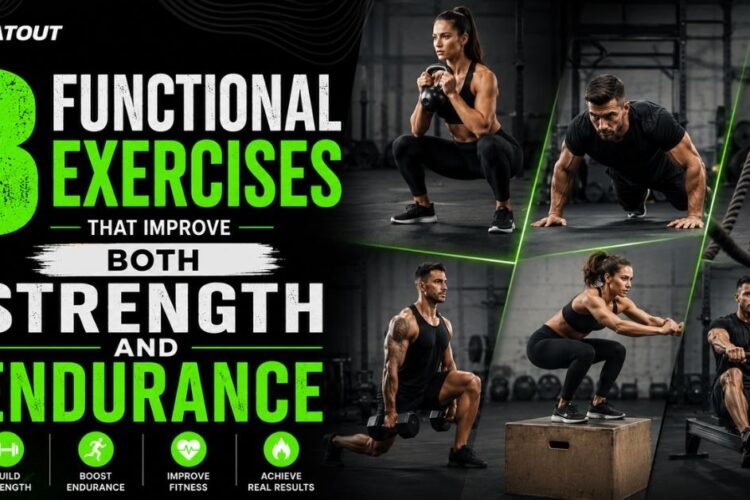
For decades, gyms have treated strength and cardio as separate pursuits. Weight racks on one side, treadmills on the other. It’s a habit that has shaped the way many people train, even though the body rarely works that way outside the gym.
Carrying grocery bags up to your third-floor apartment without an elevator, moving furniture, or chasing a toddler around the park all demand both strength and endurance. You need enough strength to handle the effort and enough endurance to keep going when your breathing gets heavier.
That’s where functional exercises come in. They train your body to produce force, keep moving, and recover without feeling completely drained.
Here are eight exercises that build strength and endurance at the same time, no dividing line required.
Why These Two Got Separated in the First Place
For years, gym floors were split down the middle. Cardio machines on one side, weight racks on the other, and a silent agreement that the two didn’t talk to each other.
A lot of that came from how easy it is to programme a single-variable workout. Add weight, or add time. Rarely both. But your body doesn’t train in silos like that. Muscles that can lift heavy and keep working under fatigue are the ones that actually hold up outside the gym, whether that’s on a hike, in a match, or halfway through a functional race.
Of course, strength and endurance are only part of the picture. Our guide, What Are the Exceptional Types of Fitness?, explores the different components of physical fitness and how they work together.
“Your body doesn’t recognise ‘strength day’ or ‘cardio day’. It only responds to the demands you place on it.”
Read: Women’s Health and Fitness: Essential Exercises for Every Age Group
8 Functional Exercises That Improve Both Strength and Endurance
Lower Body and Posterior Chain
Kettlebell Swings: The hip hinge is one of those movements that looks simple until you’ve done fifty of them in a row. Kettlebell swings train explosive power through the glutes, hamstrings, and lower back while your heart rate climbs fast. Ten minutes of swings will humble most people who think they’re fit.
Walking Lunges: Walking lunges force each leg to work on its own, which exposes imbalances a lot of bilateral lifts hide. They build single-leg strength, but the real test comes after rep twenty, when your quads are burning, and you’ve still got a room to cross.
Full-Body Load Carrying
Farmer’s Carries: Pick up something heavy, walk with it, put it down. That’s the whole exercise, but don’t mistake simple for easy. Farmer’s carries challenge your grip, shoulders, core, and legs throughout the movement, making them one of the most practical full-body exercises you can do. Keep your shoulders relaxed and avoid leaning to one side. Walking with control is more valuable than rushing the distance.
Bear Crawls: Bear crawls put your shoulders, core, and quads under constant tension while you move, which is a different kind of hard than lifting something and putting it down. Keep your hips low and your steps controlled. Rushing through this one just means you’ll gas out faster without much to show for it.
Conditioning Under Fatigue
Rowing: Every rowing stroke asks your legs, back, arms, and core to work together. That full-body movement builds strength while raising your heart rate, all without placing heavy impact on your joints. A smooth, controlled stroke will always take you further than simply pulling faster.
Mountain Climbers: Mountain climbers hit your core, shoulders, and legs all together, and your heart rate follows fast. Watch a demo video, and it looks easy. You’ll never guess how much it burns until you’re actually thirty seconds in and your form starts falling apart. That’s usually right around where people ease off, and it’s exactly the point where the exercise starts working.
Battle Ropes: Battle ropes turn a basic wave pattern into a serious test of shoulder and grip endurance, and they don’t take long to reveal who’s been skipping upper body conditioning. Waves, slams, or circles all work. Pick one, keep good form, and let the fatigue build.
Dumbbell Thrusters: A front squat flows straight into an overhead press, turning two familiar movements into one demanding exercise. It builds lower-body strength while keeping your heart rate elevated, making it a practical choice for improving both strength and endurance.
How to Add These Exercises Into Your Weekly Routine
You don’t need all eight in one session. Pick three or four, string them together with short rest, and repeat for three or four rounds. That’s usually enough to feel both systems working at once, your muscles fatiguing while your lungs are still catching up.
Beginners should start with two rounds and longer rest between exercises. Building the capacity to recover fast between hard efforts is half of what this training is actually teaching your body.
A lot of people rotate through these exercises twice a week alongside whatever else they’re already doing, whether that’s running, lifting, or a sport. You don’t need to overhaul your entire programme.
Swap one conditioning session for a circuit built from this list and you’ll notice the difference within a few weeks, mostly in how you recover between hard efforts, not just in how much you can lift.
Putting It Together
None of these exercises work in isolation, and that’s the point. Strength and endurance aren’t opposite ends of a spectrum you’re forced to choose between. They’re two capacities that get built together when the training demands it, which is exactly the kind of demand functional racing puts on your body. Events like FLATOUT combine running with functional workout stations, giving participants the opportunity to put their strength, endurance, and determination to the test in a real-world setting.
Author’s Bio:
Jennifer has spent the better part of a decade paying attention to what actually works in fitness and health. She races in functional fitness events to put her own training to the test, FLATOUT included, using them to track where she’s actually improving instead of guessing.